Path of Exile 2 Patch 0.1: Launch, Loot and Endgame Changes
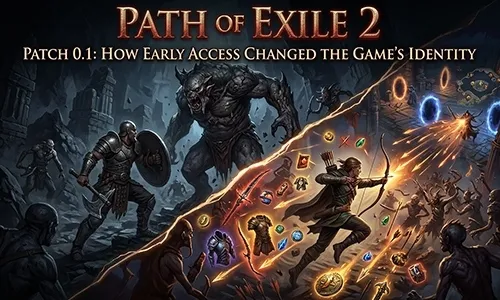
Path of Exile 2 patch 0.1 established the central tension of its early access launch: should a loot-driven action RPG prioritize deliberate, demanding combat or the steady acceleration of a powerful character? Released into early access on December 6, 2024, the game initially combined a punishing campaign, scarce equipment upgrades and consequential positioning. Its first wave of updates made progression more forgiving while exposing a divide between the campaign and endgame.
The defining issue was not simply difficulty. It was how difficulty interacted with rewards, encounter design and the time players invested in their characters. Changes to loot, dodge rolling, boss attempts and checkpoint travel improved accessibility, but also raised a larger question: which obstacles made Path of Exile 2 compelling, and which merely made it frustrating?
What Did Path of Exile 2 Offer at Launch?
The early access launch included three campaign acts, followed by a second journey through those acts on Cruel difficulty. Players could choose from six character classes, each with two Ascendancies, before progressing into the Atlas endgame. WASD movement, a revised skill gem system and a new passive tree helped distinguish the sequel’s combat and character building.
Its strongest early qualities worked together. Detailed environments established a dark, hostile world. Animation and sound gave attacks a sense of weight. Movement controls supported repositioning during encounters rather than treating movement as something that happened only between attacks.
The campaign brought those elements into focus. Smaller engagements and dangerous bosses encouraged players to watch enemy behavior, manage space and build strength gradually. Progress could feel earned because enemies remained threatening rather than becoming disposable immediately.
That same structure, however, could become exhausting when players lacked the equipment needed to overcome the next obstacle.
Why the Original PoE 2 Campaign Felt So Difficult
The launch campaign’s challenge came from several overlapping systems:
- Dangerous enemies could overwhelm characters that approached encounters carelessly.
- Bosses created progression walls for some builds.
- Rare equipment and crafting currency were scarce.
- Large areas increased the cost of exploration and backtracking.
- Certain rare monster modifiers added hazards that were especially awkward for melee characters.
These systems reinforced one another. A difficult boss was harder to overcome when a character could not find a meaningful weapon upgrade. A large zone felt longer when ordinary packs remained dangerous. Being surrounded was more punishing when escape options were limited.
Scarce rewards also encouraged players to use systems that were easy to overlook: checking NPC vendors, gambling for equipment, revisiting bosses and searching for valuable chests. The intended progression loop asked players to work with limited resources rather than expect a constant stream of replacement gear.
The design tradeoff was substantial. Scarcity could make individual items memorable, but prolonged scarcity could leave players feeling that their progress depended more on an equipment bottleneck than on improving their play.
Early Loot Changes Made Progression More Forgiving
Grinding Gear Games responded quickly. Within the opening days of early access, updates increased rewards associated with monster modifiers, improved boss drops and raised the availability of some campaign currency, including Regal Orbs.
Those adjustments mattered because equipment was a major source of character power. More opportunities to obtain or improve gear gave struggling players additional ways to progress without requiring every obstacle to be solved through execution alone. For players exploring ways to buy POE2 Items, the underlying priority remains the same: identifying equipment that addresses a specific build weakness rather than chasing upgrades without a clear purpose.
The change affected more than the quantity of rewards. It altered the campaign’s rhythm:
| Launch progression | Direction of the early changes |
|---|---|
| Fewer opportunities to replace weak equipment | More frequent chances to obtain upgrades |
| Scarce currency limited item improvement | Greater access to some crafting currency |
| Progression walls could persist while players searched for gear | Equipment offered a more accessible route past difficult encounters |
The central tradeoff was between item significance and progression consistency. A rare drop can feel more meaningful when rewards are limited, but that meaning weakens if too many players spend long stretches without finding anything useful. The early updates moved toward reducing those stalled stretches.
Dodge Roll Changes Reduced the Risk of Getting Surrounded
Patch 0.1.0d changed player collision size during dodge rolls from one unit to zero and allowed some smaller monsters to be pushed while rolling. This made escaping tight situations easier, although it was not equivalent to unrestricted phasing through every enemy.
The practical benefit was clear: players had a better chance of recovering when enemies boxed them in. The design consequence was more debatable.
In a tactical combat system, being surrounded can serve as punishment for poor positioning. If escape becomes easier, positioning mistakes become less costly. On the other hand, collision that leaves players feeling trapped can make combat seem unresponsive rather than demanding.
The disagreement therefore concerned the purpose of the obstacle. Was getting trapped a readable consequence players should learn to avoid, or an interaction that interfered with otherwise satisfying combat? The dodge roll changes favored recovery and responsiveness.
The PoE 2 Endgame Exposed a Different Set of Problems
The campaign and endgame did not always reward the same approach.
During the campaign, the emphasis fell on deliberate engagements, dangerous enemies and prominent boss encounters. In the launch Atlas, map completion often revolved around finding and killing rare monsters. Boss encounters were less frequent, and efficient clearing became increasingly important.
Returning systems such as Breach, Ritual and Delirium further complicated that transition. Their dense encounters could create situations in which slower skills and committed attack animations felt poorly matched to the volume of incoming threats.
That mismatch was particularly important for characters built around slower melee attacks. A skill could feel appropriate in a readable campaign encounter yet become awkward when surrounded by dense packs, overlapping effects and pressure to keep moving.
The issue was not that every endgame encounter needed to resemble a campaign boss. It was that the transition could make the campaign feel like preparation for a different style of combat.
Why Death Penalties Made the Mismatch Worse
At launch, dying in an endgame map ended the run. Major encounters such as the Arbiter of Ash also imposed severe consequences for failure, limiting players’ opportunities to learn through repeated attempts.
That structure combined fast, sometimes visually crowded encounters with a low tolerance for mistakes. Players could lose access to an encounter before they had enough experience to understand it.
A demanding boss and a costly learning process are separate design decisions. The former tests execution; the latter determines how much time or investment a player must risk to practice.
How Patch 0.1.1 Changed the Endgame
Patch 0.1.1 addressed several early endgame complaints by increasing monsters and encounters in maps, adjusting problematic enemy abilities and introducing additional attempts for the Arbiter of Ash. The encounter could offer up to six respawn attempts, depending on difficulty. Later updates extended additional-attempt systems to other major encounters.
These changes targeted distinct problems:
- More encounters addressed maps that felt sparse or unrewarding.
- Additional boss attempts gave players more room to learn.
- Enemy adjustments reduced the impact of particular attacks and hazards.
- Improvements to visual clarity helped make some dangerous effects easier to read.
Not all of these adjustments should be treated as the same kind of difficulty reduction. Making an attack more visible improves the information available to the player. Reducing its damage changes the punishment for failing to respond. Adding retries changes the cost of learning.
Separating those effects helps explain why an update could improve fairness while still prompting disagreement about the game’s direction.
The Cast on Freeze Nerf and the Cost of Rebuilding
The Cast on Freeze controversy became one of patch 0.1’s most significant balance disputes. Changes to trigger gems and energy generation sharply reduced the effectiveness of builds that relied on repeatedly triggering spells through freezes.
The underlying conflict was straightforward. Early access gives developers a reason to correct extreme interactions before they shape the entire game. Players, however, still invest real time in leveling, acquiring equipment and constructing a functioning build.
A major nerf can therefore have consequences beyond lower damage. A character’s passive choices, equipment and skill setup may no longer work together effectively. Even an available passive reset would not necessarily replace the gear or resources needed for a different build. When comparing replacement gear—including listings for cheap POE2 Items — compatibility matters more than price alone: an inexpensive item offers little value if it does not support the revised build.
The backlash exposed tension between rapid experimentation and character stability. It also contributed to a more cautious approach to disruptive balance changes during an ongoing progression cycle.
The broader lesson is that balance changes need to account for transition costs, not just the numerical strength of the mechanic being changed.
Checkpoint Fast Travel: Less Backtracking, Different Exploration
Patch 0.1.0e added fast travel between checkpoints within an area, responding to complaints about large campaign zones and excessive navigation. Checkpoints later became part of endgame maps as well.
For players frustrated by retracing cleared routes, the benefit was immediate: less time spent walking through familiar territory.
The criticism was that fast travel treated the symptom rather than the underlying level-design issue. Smaller areas, more meaningful encounters or clearer routes could also address tedious navigation while preserving the experience of physically moving through a connected environment.
This illustrates a recurring problem in live game development. A convenience feature can solve an urgent frustration while establishing a lasting expectation. Once players organize their experience around that convenience, removing it becomes much harder.
Did Patch 0.1 Improve Path of Exile 2?
The answer depends on which part of the launch experience mattered most.
For players blocked by scarce upgrades, awkward collisions, costly boss failures or long backtracking routes, the early changes addressed tangible problems. More accessible rewards, easier escape and additional attempts made progression less punishing.
For players drawn to the original campaign’s scarcity and tension, those same changes could weaken the qualities that made the sequel feel distinctive. The concern was not necessarily that every convenience was harmful, but that many small adjustments could collectively shift the game toward a more familiar, faster-paced action RPG structure.
Neither perspective requires treating the launch build as flawless. Its campaign could be compelling while its endgame remained inconsistent. Its difficulty could create memorable encounters while some modifiers remained poorly suited to the combat system.
The most useful distinction is between preserving challenge and preserving friction. They sometimes overlap, but they are not interchangeable.
Frequently Asked Questions
Why was loot controversial in PoE 2 patch 0.1?
Rare equipment and some crafting currencies were scarce at launch, which could make character progression difficult. Early updates increased rewards and access to upgrades, improving progression while prompting debate over whether individual drops had become less meaningful.
What happened to Cast on Freeze?
Changes to trigger-gem energy generation substantially weakened builds centered on Cast on Freeze. The resulting backlash highlighted the disruption caused when players had already invested in specialized characters and equipment.
What did patch 0.1.1 change?
Patch 0.1.1 increased endgame encounters, adjusted problematic monsters and introduced additional attempts for the Arbiter of Ash based on encounter difficulty. These changes aimed to improve map activity, fairness and opportunities to learn major fights.
Was the launch campaign the same as the endgame?
No. The campaign emphasized more deliberate encounters and frequent memorable bosses, while the launch endgame placed greater emphasis on rare-monster hunting, clearing efficiency and dense returning encounter systems. That contrast was a central source of criticism during the 0.1 period.
Tags
Latest Articles
-
- Path of Exile 2 Patch 0.1: Launch, Loot and Endgame Changes
- ARC Raiders PvE Mode Guide: Rules, Loot Changes, and Best Uses
- Modern Warfare 4 DMZ Threat Level Comparison Guide
- Templar Complete Guide: Main Tank Playstyle and Skill Priority
- Diablo 4 S15 Infinity Runeword Guide
- FC 27 Kickabouts Guide: Rules, Modes, and Tips
Categories
-
- Pokemon TCG Pocket ( 6 )
- Fallout 76 ( 12 )
- Monster Hunter Wilds ( 2 )
- Diablo 4 ( 26 )
- call of duty black ops 6 ( 14 )
- Monopoly Go ( 7 )
- WoW Classic ( 2 )
- GTA 5 ( 5 )
- Elden Ring ( 8 )
- Minecraft ( 1 )
- Helldivers 2 ( 11 )
- Goddess of Victory Nikke ( 2 )
- WoW Mop Classic ( 3 )
- Dune Awakening ( 3 )
- Path of Exile ( 3 )
- Marvel Rivals Bundles ( 7 )
- Last Epoch ( 2 )
- Grow a Garden ( 24 )
- buy cod bo7 bot lobbies ( 4 )
- adopt me pets ( 8 )
- Steal a Brainrot items ( 12 )
- path of exile 2 ( 3 )
- Battlefield 6 ( 2 )
- Forza Horizon 6 ( 2 )
- mlb 26 ( 1 )
- College Football 27 ( 1 )
- Grow A Garden 2 ( 1 )
- Aion 2 ( 2 )
- Dark and Darker ( 1 )
- Skull and Bones ( 1 )
- Path of Exile 1 ( 1 )
- Madden NFL 27 ( 1 )
- Call of Duty: MW4 ( 3 )
- NBA 2K27 ( 2 )
- Hero Siege ( 1 )
- ARC Raiders ( 2 )
- FC 27 ( 1 )
- FC 25 ( 1 )